
PMS Minimum Investment Explained: Why ₹50 Lakh, What Counts

If you've started looking at Portfolio Management Services, you've already run into the number: ₹50 lakh. It's the first gate every investor has to clear before a portfolio manager can even open an account. But most explanations stop at "SEBI says so" — they don't tell you why the number is what it is, whether cash is the only thing that counts, or what happens if your portfolio dips below the line six months after you've invested. This guide answers all of that, in order: where ₹50 lakh comes from, what actually counts toward it, what doesn't, and how it compares to the entry points of Alternative Investment Funds (AIFs) and mutual funds — so you know exactly where you stand before you talk to a manager.
The Short Answer: PMS Minimum Investment Is ₹50 Lakh
SEBI requires every Portfolio Manager to accept a minimum of ₹50 lakh from a client, either as cash, as securities valued at ₹50 lakh, or a combination of both. This has been the regulatory floor since the SEBI (Portfolio Managers) Regulations, 2020 came into force, replacing the earlier ₹25 lakh limit. Individual PMS providers are free to set their own minimum above this floor some do, some don't but no SEBI-registered portfolio manager can accept less.
That's the rule in one line. The interesting part is what sits underneath it.
Where the ₹50 Lakh PMS Minimum Investment Comes From
The minimum hasn't always been ₹50 lakh, and it hasn't moved often. There have been exactly three thresholds in the history of PMS regulation in India:
Year Minimum investment Change 1993 ₹5 lakh PMS introduced as a regulated product 2012 ₹25 lakh First revision, 5x increase 2020 ₹50 lakh Current floor, doubled againSEBI doubled the threshold twice, but never more often than once a decade. That pattern matters: it tells you the ₹50 lakh floor isn't a soft guideline that gets revised annually — it's a structural feature of how PMS is positioned in India's investment landscape, sitting well above mutual funds and well below the ₹1 crore floor for Alternative Investment Funds.
The 2020 revision came through the SEBI (Portfolio Managers) Regulations, 2020, which replaced the 1993 regulations entirely. Alongside the higher client minimum, the same regulation raised the net worth requirement for portfolio managers themselves from ₹2 crore to ₹5 crore — a signal that SEBI was tightening the whole PMS ecosystem on both sides of the table, not just the investor's entry ticket.
Why SEBI Set the PMS Minimum Investment This High
Three reasons show up consistently across regulatory commentary and how the product is actually structured:
- PMS portfolios are concentrated, not diversified. A PMS typically holds 15 to 30 stocks in your own demat account, compared to the 50–100 holdings inside a typical diversified mutual fund. Concentration is the entire point of paying for active management — it's how a manager's conviction shows up in your returns — but it also means a single bad call moves your portfolio meaningfully. SEBI's logic is that only investors with real capital depth should be exposed to that.
- It's a suitability filter, not a random hurdle. Below ₹25–30 lakh, regulators observed investors entering PMS without fully grasping concentrated-portfolio risk, the fee structure, or the volatility involved. The higher floor is meant to keep out participation that isn't genuinely informed or financially cushioned.
- The economics only work at scale. Custodian charges, brokerage, demat administration, and reporting costs are largely fixed regardless of portfolio size. On a small portfolio, these costs eat a disproportionate share of returns. A higher floor keeps the fee-to-return math sensible for the investor, not just the manager.
What Counts Toward the ₹50 Lakh PMS Minimum Investment
This is where most explanations get vague, so here's the precise breakdown.
Cash Investment
Straightforward — you transfer ₹50 lakh or more into the PMS account, and the manager deploys it according to your agreed strategy.
Existing Securities via In-Specie Transfer
You can also fund a PMS account by transferring shares you already own — an in-specie transfer — rather than liquidating them first. If you already hold a portfolio of, say, ₹40 lakh in Reliance, HDFC Bank, and a handful of mid-caps, and add ₹10 lakh in cash, that combination can satisfy the ₹50 lakh requirement, provided the total value clears the threshold at onboarding.
This detail matters more than it looks. Selling first and reinvesting through the PMS would trigger capital gains tax on the sale — an in-specie transfer lets you retain the holdings you already believe in without an unnecessary tax event, then let the manager restructure the portfolio from there according to the mandate.
A Mix of Cash and Securities
Most onboarding in practice is a blend: part cash, part existing holdings, valued together at the point of entry. SEBI's own FAQ on Portfolio Managers confirms this directly — the portfolio manager is required to accept a minimum of ₹50 lakh in funds, or securities of that value, from each client. Cash and securities are treated as interchangeable ways of clearing the same bar.
What Doesn't Count Toward the PMS Minimum Investment
A few things people assume might help clear the threshold, but don't:
- Borrowed money or leverage. SEBI regulations prohibit portfolio managers from borrowing funds or securities on a client's behalf, and PMS does not permit leverage on equity portfolios (hedging-related derivative use is a separate, narrower allowance). The ₹50 lakh has to be genuinely your capital or securities.
- Committed-but-undelivered capital. A promise to transfer funds later doesn't count. The value has to actually sit in the account, or be transferred in, before the manager starts deploying.
- Assets outside the PMS account. Your mutual fund holdings, fixed deposits, or direct equity sitting in a separate demat account don't count toward this specific ₹50 lakh — only what's placed into the PMS structure does.
Does the PMS Minimum Investment Apply Per Strategy?
This is one of the more practical questions investors run into once they've cleared the basic minimum. If a portfolio manager offers multiple strategies, say, a large-cap strategy and a mid-cap strategy the regulatory floor applies at the client-manager relationship level, but managers can and do set per-strategy minimums within that. A client bringing ₹50 lakh in total might be able to split it across two strategies, provided each individual allocation meets the manager's own stated minimum for that strategy (commonly ₹10–25 lakh per strategy, set by the provider, not SEBI). Always check the individual manager's disclosure document this is one area where SEBI sets the floor, but the manager sets the finer print.
What Happens If Your PMS Portfolio Falls Below ₹50 Lakh
This is the question almost nobody asks before investing, and it matters. Markets fall. If your PMS portfolio's value drops below ₹50 lakh purely because of market movement, you are not required to top it up. SEBI's clarificatory FAQs on the 2020 regulations addressed this directly: the ₹50 lakh requirement is a condition of entry, not a running maintenance obligation tied to market value.
The rule that does apply is around withdrawals. SEBI's own FAQ on Portfolio Managers is specific here: partial withdrawal is permitted "while ensuring that requisite minimum investment of INR 50 lakh is maintained." Read together with the no-top-up rule, this means that if a market fall has already taken your account below ₹50 lakh, you cannot withdraw anything further until the value recovers back above that line — a market downturn to ₹42 lakh isn't a compliance issue in itself, but it does freeze withdrawals until the portfolio value is restored. Market drops and voluntary withdrawals are governed by two separate clauses, and it's worth not conflating them.
PMS vs AIF vs Mutual Fund Minimum Investment Compared
The minimum hasn't always been ₹50 lakh, and it hasn't moved often. There have been exactly three thresholds in the history of PMS regulation in India:
Year Minimum investment Change 1993 ₹5 lakh PMS introduced as a regulated product 2012 ₹25 lakh First revision, 5x increase 2020 ₹50 lakh Current floor, doubled againSEBI doubled the threshold twice, but never more often than once a decade. That pattern matters: it tells you the ₹50 lakh floor isn't a soft guideline that gets revised annually — it's a structural feature of how PMS is positioned in India's investment landscape, sitting well above mutual funds and well below the ₹1 crore floor for Alternative Investment Funds.
The 2020 revision came through the SEBI (Portfolio Managers) Regulations, 2020, which replaced the 1993 regulations entirely. Alongside the higher client minimum, the same regulation raised the net worth requirement for portfolio managers themselves from ₹2 crore to ₹5 crore — a signal that SEBI was tightening the whole PMS ecosystem on both sides of the table, not just the investor's entry ticket.
Why SEBI Set the PMS Minimum Investment This HighThree reasons show up consistently across regulatory commentary and how the product is actually structured:
- PMS portfolios are concentrated, not diversified. A PMS typically holds 15 to 30 stocks in your own demat account, compared to the 50–100 holdings inside a typical diversified mutual fund. Concentration is the entire point of paying for active management — it's how a manager's conviction shows up in your returns — but it also means a single bad call moves your portfolio meaningfully. SEBI's logic is that only investors with real capital depth should be exposed to that.
- It's a suitability filter, not a random hurdle. Below ₹25–30 lakh, regulators observed investors entering PMS without fully grasping concentrated-portfolio risk, the fee structure, or the volatility involved. The higher floor is meant to keep out participation that isn't genuinely informed or financially cushioned.
- The economics only work at scale. Custodian charges, brokerage, demat administration, and reporting costs are largely fixed regardless of portfolio size. On a small portfolio, these costs eat a disproportionate share of returns. A higher floor keeps the fee-to-return math sensible for the investor, not just the manager.
This is where most explanations get vague, so here's the precise breakdown.
1. Cash InvestmentStraightforward — you transfer ₹50 lakh or more into the PMS account, and the manager deploys it according to your agreed strategy.
2. Existing Securities via In-Specie TransferYou can also fund a PMS account by transferring shares you already own — an in-specie transfer — rather than liquidating them first. If you already hold a portfolio of, say, ₹40 lakh in Reliance, HDFC Bank, and a handful of mid-caps, and add ₹10 lakh in cash, that combination can satisfy the ₹50 lakh requirement, provided the total value clears the threshold at onboarding.
This detail matters more than it looks. Selling first and reinvesting through the PMS would trigger capital gains tax on the sale — an in-specie transfer lets you retain the holdings you already believe in without an unnecessary tax event, then let the manager restructure the portfolio from there according to the mandate.
3. A Mix of Cash and SecuritiesMost onboarding in practice is a blend: part cash, part existing holdings, valued together at the point of entry. SEBI's own FAQ on Portfolio Managers confirms this directly — the portfolio manager is required to accept a minimum of ₹50 lakh in funds, or securities of that value, from each client. Cash and securities are treated as interchangeable ways of clearing the same bar.
What Doesn't Count Toward the PMS Minimum InvestmentA few things people assume might help clear the threshold, but don't:
- Borrowed money or leverage. SEBI regulations prohibit portfolio managers from borrowing funds or securities on a client's behalf, and PMS does not permit leverage on equity portfolios (hedging-related derivative use is a separate, narrower allowance). The ₹50 lakh has to be genuinely your capital or securities.
- Committed-but-undelivered capital. A promise to transfer funds later doesn't count. The value has to actually sit in the account, or be transferred in, before the manager starts deploying.
- Assets outside the PMS account. Your mutual fund holdings, fixed deposits, or direct equity sitting in a separate demat account don't count toward this specific ₹50 lakh — only what's placed into the PMS structure does.
This is one of the more practical questions investors run into once they've cleared the basic minimum. If a portfolio manager offers multiple strategies, say, a large-cap strategy and a mid-cap strategy the regulatory floor applies at the client-manager relationship level, but managers can and do set per-strategy minimums within that. A client bringing ₹50 lakh in total might be able to split it across two strategies, provided each individual allocation meets the manager's own stated minimum for that strategy (commonly ₹10–25 lakh per strategy, set by the provider, not SEBI). Always check the individual manager's disclosure document this is one area where SEBI sets the floor, but the manager sets the finer print.
What Happens If Your PMS Portfolio Falls Below ₹50 LakhThis is the question almost nobody asks before investing, and it matters. Markets fall. If your PMS portfolio's value drops below ₹50 lakh purely because of market movement, you are not required to top it up. SEBI's clarificatory FAQs on the 2020 regulations addressed this directly: the ₹50 lakh requirement is a condition of entry, not a running maintenance obligation tied to market value.
The rule that does apply is around withdrawals. SEBI's own FAQ on Portfolio Managers is specific here: partial withdrawal is permitted "while ensuring that requisite minimum investment of INR 50 lakh is maintained." Read together with the no-top-up rule, this means that if a market fall has already taken your account below ₹50 lakh, you cannot withdraw anything further until the value recovers back above that line — a market downturn to ₹42 lakh isn't a compliance issue in itself, but it does freeze withdrawals until the portfolio value is restored. Market drops and voluntary withdrawals are governed by two separate clauses, and it's worth not conflating them.
PMS vs AIF vs Mutual Fund Minimum Investment ComparedBecause the ₹50 lakh figure only means something in contrast to the alternatives, here's where it sits:
Vehicle Minimum investment Structure Mutual fund As low as ₹500 (SIP) Pooled — you hold units, not the underlying shares PMS ₹50 lakh (SEBI floor) Direct ownership — shares sit in your own demat AIF (Cat I / II / III) ₹1 crore Pooled, privately placed — units in a fund vehicle GIFT City / IFSC PMS US$70,000 (~₹58–60 lakh, rate-dependent) Direct ownership, USD-denominated, for NRIs and global investorsThe jump from mutual funds to PMS is roughly 1,000x in the minimum ticket — that's not incidental, it reflects the shift from a pooled, standardised product to a direct, customised one where you personally bear each trade's tax consequence. The further jump to AIF territory (₹1 crore) reflects a move from listed-equity concentration to genuinely illiquid, longer-lock-in strategies — private equity, structured credit, long-short funds — that PMS, confined largely to listed securities, cannot access.
If you're trying to work out which of these three actually fits your situation rather than just which one you technically qualify for, our PMS vs Mutual Funds guide walks through the comparison in more depth.
Is ₹50 Lakh Enough, or Just the PMS Entry Price?
Here's the honest nuance that most marketing pages skip: clearing ₹50 lakh gets you in the door, but it isn't necessarily the amount at which PMS makes the most sense for you.
The reasoning is fee mathematics, not eligibility. PMS fixed fees typically run 1–2.5% of assets annually, and even hybrid/performance structures carry meaningful minimum costs — custodian charges, brokerage, GST, and exit loads on top. On a ₹50 lakh account, a 2% fixed fee is ₹1 lakh a year regardless of how the market performs. That's a larger drag, proportionally, than the same fee on a ₹2–5 crore account, because the fixed operational costs (custody, reporting, compliance) don't scale down with portfolio size.
A commonly cited rule of thumb among wealth advisors: PMS works best when it represents 10–20% of your total equity exposure, which implies your total investable equity should ideally be in the ₹2.5–5 crore range before PMS becomes the efficient choice rather than merely the eligible one. If ₹50 lakh would represent the bulk of your liquid net worth, a well-chosen mutual fund or a diversified direct equity portfolio may serve you better until your capital base grows — concentration risk is harder to absorb when it's a large share of everything you own. Our who-should-invest guide goes deeper into matching ticket size, horizon, and risk appetite to the right product.
Why Some PMS Providers Set a Higher Minimum Than SEBI
SEBI's ₹50 lakh is a floor, not a fixed price. Portfolio managers are free to set their own minimum above it, and several do, particularly for concentrated or high-conviction strategies aimed at a narrower client base. It isn't unusual to see individual strategies with minimums well above the regulatory floor — sometimes several times higher, depending on how selective the manager wants to be about client depth and portfolio construction. The regulatory number tells you the lowest possible entry point across the entire industry; it does not tell you what any specific manager will actually ask for. Always check the current disclosure document for the exact figure before assuming ₹50 lakh is what you'll be asked to bring.
PMS Minimum Investment Rules for NRIs
NRIs can invest in PMS on largely the same terms as resident Indians, typically routing funds through NRE or NRO accounts, subject to standard KYC, FEMA, and repatriation rules. The ₹50 lakh minimum applies equally. Where it gets more interesting is GIFT City / IFSC-based PMS, which quotes its minimum in US dollars (US$70,000) rather than rupees, and offers a lighter tax regime along with faster repatriation — typically within a couple of days. If you're investing from abroad, it's worth comparing a standard onshore PMS against a GIFT City structure before deciding where your ₹50 lakh-equivalent should sit. Our glossary breaks down GIFT City, repatriation, and related terms in plain English if you want the vocabulary sorted first.
Next Steps: Choosing the Right PMS for Your Minimum Investment
The ₹50 lakh figure is simple on the surface and does a lot of quiet work underneath — it's a suitability filter, a signal about portfolio concentration, and a number that only makes sense next to the ₹1 crore AIF floor and the near-zero mutual fund entry point. Knowing what counts toward it (cash, securities, or both) and what doesn't (borrowed capital, promises, outside assets) is the difference between walking into a PMS conversation informed and walking in guessing.
If you're trying to work out whether ₹50 lakh is the right amount for your situation — not just the regulatory minimum —comparing PMS, AIF, and GIFT City options side by side or asking Nyra to score your fit against fees, concentration, and manager track record is a faster way to get a straight answer than reading another ten pages of fine print. You can also read our companion guides on what a PMS actually is,how PMS fees and hurdle rates work, andthe SEBI safeguards behind every PMS structure.
PMS Sahi Hai is a distributor of Portfolio Management Services and Alternative Investment Funds, APMI-registered (Registration No. APRN08358). This article is for education only and is not investment advice, a recommendation, or an offer to buy or sell any security. Investments in securities markets are subject to market risks; read all scheme-related documents carefully. Past performance is not indicative of future results. Consult your advisor before investing.
Ishaan founded PMS Sahi Hai to make India's PMS, AIF and GIFT City markets legible to serious investors — comparing every SEBI-registered manager on the same seven pillars, with no shelf products and no commission bias.
Frequently asked
Can I use a mix of cash and shares I already own to meet the ₹50 lakh minimum?
Yes. This is called an in-specie transfer, and it's a standard way to onboard. The combined value of the cash and existing securities you transfer in has to clear ₹50 lakh at the time you open the account.
If my PMS portfolio value falls below ₹50 lakh due to market losses, do I have to add more money?
No. SEBI's FAQs confirm there's no obligation to top up if the fall is purely due to market valuation. But there's a related restriction worth knowing: you also can't withdraw anything from the account while it remains below ₹50 lakh — partial withdrawals are only allowed if the requisite minimum stays intact afterward, so a below-threshold portfolio effectively has withdrawals frozen until it recovers.
Can I invest via SIP or in monthly instalments to reach the ₹50 lakh minimum?
No. The ₹50 lakh has to be cleared upfront, in a single onboarding transaction — either as cash, as securities, or a mix of both. There's no SIP-style route to accumulate your way to the initial threshold the way you might with a mutual fund. Once the account is open and the ₹50 lakh floor has been met, many portfolio managers do accept further contributions on top of the base amount, though the size and process for these top-ups is set by the individual manager's disclosure document, not by SEBI, so it's worth confirming with the specific provider rather than assuming a standard figure.
Does the ₹50 lakh apply separately to each PMS strategy I invest in?
The SEBI floor applies at entry into the PMS relationship; how it's split across multiple strategies with one manager depends on that manager's own disclosure document and per-strategy minimums, which are typically lower than ₹50 lakh individually but must add up sensibly across your total commitment.
Is ₹50 lakh the amount I should actually invest, or just the minimum I'm allowed to?
It's the minimum you're allowed to invest. Many practitioners suggest PMS works better as 10–20% of a larger equity portfolio often implying a total equity base of ₹2.5–5 crore rather than as the near-entirety of your investable wealth.
Can I borrow money to reach the ₹50 lakh threshold?
No. Portfolio managers cannot borrow funds or securities on your behalf, and the capital or securities you bring in need to be genuinely yours, not leveraged.
Keep reading
All articles
What is Thematic PMS?
Thematic PMS concentrates a managed portfolio around one big structural trend, from AI to clean energy. Here is how it works, where it shines, and the risks HNI and NRI investors must weigh before committing.
Equity vs Debt Funds — Which Suits Your Goal?
India's July 2024 capital gains tax overhaul changed the maths for PMS, AIFs, smallcases and mutual funds. Here's how each vehicle is affected, and the strategy shifts that follow.
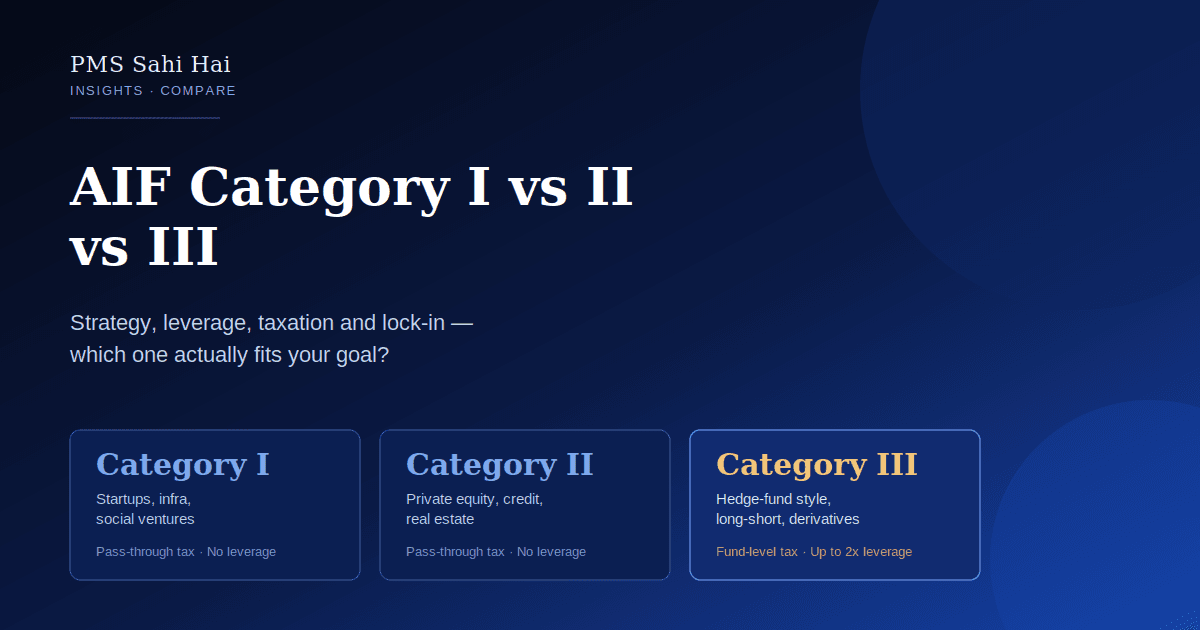
AIF Category I vs II vs III: Which One Actually Fits Your Goal
Read it. Now pressure-test it.
Ask Nyra how this applies to your portfolio, or talk to a SEBI-registered advisor — no pitch, no pressure.